
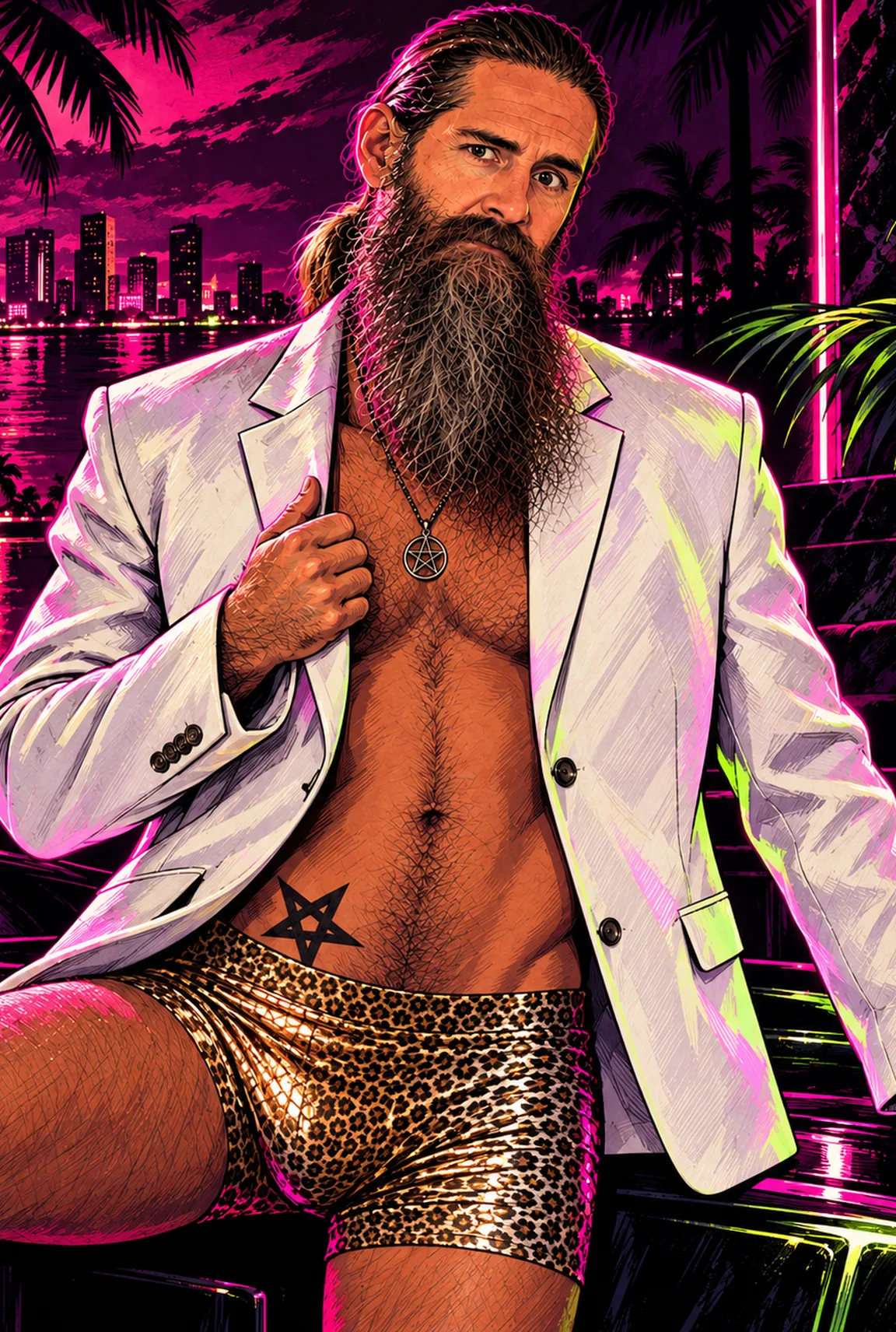
Somewhere around 2022, the internet collectively discovered that men have thighs.
Suddenly every other video was about five-inch inseams, exposed quads and the arrival of Hoochie Daddy Summer. Men who had spent most of their adult lives in cargo shorts hovering somewhere around the kneecap were being encouraged to hike that hemline north and let nature take its course, and everybody reacted as though the male upper thigh had just been invented.
It had not. The name is new. The man is not. He has been a basketball player, a tennis player, a disco casualty, a leather daddy, a rock star, a gym rat, and very possibly somebody’s father in a photograph the family would now prefer to keep in a drawer. Men used to show a hell of a lot more leg, and nobody needed a TikTok trend to explain it.
Before He Was a Hoochie Daddy, He Was Just Dressed
The quickest way to kill the idea that short shorts on men are new is to look at old sports photos. The original NBA uniform came with shorts that had about a three-inch inseam, and for decades pro players ran the court in hems that would now get a man called a Hoochie Daddy in the comments within seconds.
Tennis wasn’t any more modest. By the mid-1970s Björn Borg was winning in a fitted Fila polo and shorts that stopped very high on the thigh, and John McEnroe spent the late seventies and early eighties yelling at umpires in shorts cut about the same. Nobody stopped a match to ask whether that much quadricep threatened Western civilization. It was sportswear. The thigh was just… there, and because it was normal, it didn’t carry anything like the charge it does now.
The Seventies Let Everybody Out
Then came the 1970s, a decade that looked at conservative menswear and apparently decided fabric had become an administrative burden.
Coming off the Peacock Revolution, men’s clothes got brighter, tighter and much more interested in the body underneath them. Shirts hugged the chest. Pants hugged basically everything else. Wide belts pulled in the waist, hair got longer, heels got higher, and polyester went places polyester probably should never have gone. Stretch fabrics let clothes cling to a body instead of hanging somewhere in its general vicinity, and the shorts, on the court, at the beach and at the roller rink, kept getting shorter.
The real shift was that men were allowed to look decorative. Modern mainstream menswear runs on studied nonchalance: look good, just never look like you tried. The seventies did not have that problem. A man could put on tight pants, an open shirt, a gold chain, boots and his entire chest-hair situation and walk out the door fully intending to be perceived.
I support this.
Queer Men Were Already Way Ahead of Everybody
Any history of sexy menswear that skips queer culture is missing half the story, and probably the better half.
After Stonewall, gay men were using clothes to celebrate, exaggerate and deliberately display the male body years before straight-guy fashion rediscovered the short inseam. The Museum at FIT put it on the record in its exhibition A Queer History of Fashion: 1970s Castro Street style, with short shorts that revealed the body, bandannas and keys worn as a sexual code, and leather that nodded to leathersex. Right next to it stood the clone, an idealized working-class man assembled on purpose out of jeans, a tank top, work boots, a bomber jacket, usually a moustache and a newly gym-built body.
That’s the part I find fascinating. The look wasn’t a rejection of masculinity. It turned the volume all the way up on it: broad shoulders, hairy chests, thick thighs, denim, boots, leather, a body that was very clearly meant to be looked at. Masculine and sexy weren’t opposing ideas. They were the same outfit. Not everybody inside the community loved it, either. The earliest recorded use of “clone” comes from activist Arthur Evans, who wheatpasted satirical posters around the Castro mocking what he saw as butch conformity. Which is reassuring, honestly. Every scene in history has had somebody in the corner rolling their eyes at everybody else’s outfit.
Mainstream fashion has borrowed from queer style for decades and still acts surprised every time one of those ideas wanders into a suburban mall. When Damon Young tried a pair of hoochie daddy shorts for a Washington Post column in 2022, even he admitted it was something queer men had been doing “well, forever.”
The Hoochie Daddy did not appear the day straight men found five-inch inseams. He had already been at the club.

And Then There Was the Male Crop Top
We have developed the same collective amnesia about men’s stomachs.
Nobody can quite agree on who cropped first, but the male crop top grew up in gyms and on football fields. The story bodybuilders tell is that in the early seventies they started cutting the bottoms off their shirts to get around gym rules against training shirtless. College football players were showing midriff as early as 1971, and by the mid-eighties it was everywhere, with players hacking off their jerseys or tying them up behind their backs. The 1980s Miami Hurricanes, never a team to undersell themselves, made abs-out part of the swagger. Then Prince put on a cropped top in 1986 and took the whole thing somewhere else entirely.
If you had spent months building a body you were extremely proud of, you were not rushing to bury it under an XL T-shirt. A crop top on a man also just works. It breaks up the torso, shows the waist, makes the legs look longer and puts tattoos on display where a normal shirt would hide them. And depending on what is happening south of the waistband, the whole silhouette gets a lot more interesting.
So the proto-Hoochie Daddy uniform was already sitting right there: tiny shorts, cropped shirt, tube socks, sneakers, and confidence bordering on criminal negligence. We just failed to name him at the time.
Then Men’s Shorts Fell Down
Fashion is cruel, and sooner or later every silhouette gets replaced by its exact opposite.
When Michael Jordan got to the Bulls in 1984, he wanted to keep wearing his North Carolina practice shorts under his uniform for luck, so he asked for longer, roomier game shorts to hide them. Everybody wanted to dress like Michael Jordan. By the early nineties, Michigan’s Fab Five were wearing their shorts past the knee (the Flyin’ Illini would like you to know they did it first), and hip-hop and streetwear were pushing oversized everything into the mainstream. By 1997 the NBA was spelling out in its rules exactly how far above the knee shorts had to end, and it was still fining players over it in 2001. A professional sports league had to police a hemline. John Stockton kept wearing short shorts until he retired in 2003, one lone holdout of thigh in a sea of fabric, and I think about that more than I should.
The rest of menswear followed. Jeans widened, shirts grew, and shorts crept toward the knee and sometimes kept going as though they were trying to become pants. A whole generation grew up thinking knee-length was simply what shorts were. Nothing about the male leg had changed. But give people thirty years of fabric over the thigh, and six extra inches of leg starts to feel like an event.
The Great Thigh Restoration
Eventually menswear shrank again. Suits got slimmer, jeans tapered, and shorter inseams quietly found their way back into stores. Then social media turned the male body into public entertainment on a scale previous generations could only dream of, and everybody suddenly had opinions about men’s thighs.
The phrase itself had been floating around since at least 2011, but it exploded in the spring of 2022: hoochie daddy shorts, fitted and short enough to show a healthy amount of mid-to-upper thigh. It stuck because it described more than an inseam. A Hoochie Daddy is not simply wearing short shorts. He knows his legs are out, he knows you noticed, and he has chosen not to correct the situation.
Which is also why it was never really about having the right body. One viral TikTok breakdown of the rules declared toned legs and lotion mandatory. I will co-sign the lotion. The rest is negotiable. Plenty of men who have never done a leg day in their lives wear these beautifully. The thighs are not the qualification. The attitude is.
It outlived the meme cycle, too. By 2024 British GQ was asking why slutty short shorts refuse to die, and American GQ was declaring that short shorts had taken over the summer. And because fashion is fashion, this summer Vogue announced a big-shorts season and hemlines started sliding back toward the knee. Give it twenty years. Somebody’s grandson will rediscover the thigh and think he invented it.
Why Does It Feel So Sexy Now?
There is nothing objectively erotic about an inseam measurement. A thigh does not become more sexual because three more inches of it are visible. The charge comes from expectation. Mainstream men’s clothing spent decades hiding the waist, the hips and the upper thigh, until those parts of the male body became visually unusual in everyday life. So somebody puts on a pair of tiny shorts and your brain simply goes: thigh.
Crop tops, tight pants, low-rise jeans and leather all do the same thing. They don’t just show skin. They show shape. Waist, hips, ass, legs. And yes, sometimes the pants are providing additional information.
The Bulge Is Not a National Emergency
Men have anatomy. This remains true after they put on pants. If those pants happen to be fitted, stretchy, short, thin or otherwise cooperative, occasionally a bulge is going to become part of the silhouette, and everyone will survive.
Women’s clothing has spent generations deliberately emphasizing the body. Cleavage is engineered. Waists are cinched. Butts are lifted. Entire dresses are cut to manufacture shape. Then a man wears a pair of fitted shorts and people act like the garment leaked classified information.
Sometimes the shorts are simply providing context. Some of us are visual learners.
The Internet Didn’t Invent Him
The Hoochie Daddy is not proof that men suddenly got braver. He is proof that fashion forgot its own history. Men wore tiny shorts before TikTok and crop tops before Instagram. Athletes showed thigh. Gay men showed thigh and built a whole visual language around it. Rock stars showed everything they could legally get away with. Then menswear got baggy, the memory faded, and a perfectly ordinary old silhouette became provocative again.
Which means somewhere right now, a twenty-two-year-old is proudly discovering five-inch inseams while his dad has a 1980s yearbook photo in gym shorts that makes him look deeply conservative.
The internet did not invent slutty menswear. It renamed it.
The Hoochie Daddy has always been among us.
He just used to answer to Steve.
Want a note when the next one goes up? Get New Posts on the homepage. No calendar, no drip, 21+.
Research trail
This piece was checked against NBA.com’s uniform history, ESPN reporting on Michael Jordan’s shorts and the NBA’s hemline fines, Fondazione FILA’s Borg archive, the Museum at FIT’s A Queer History of Fashion, MEL Magazine and The Guardian on the male crop top, Know Your Meme and Damon Young’s 2022 Washington Post column on the term itself, and GQ, British GQ and Vogue on where shorts went next. Who cropped the first men’s shirt remains genuinely unsettled, so I left it that way.